

Benchmarks
Are your Google Ads results actually good?
Without the right context, a strong CPC or CTR can be meaningless.
These free benchmarks tell you exactly where you stand, by industry, and by campaign type.
Are your Google Ads results actually good?
Without the right context, a strong CPC or CTR can be meaningless.
These free benchmarks tell you exactly where you stand, by industry, and by campaign type.
Why it matters
Context is what separates good data from a good decision.
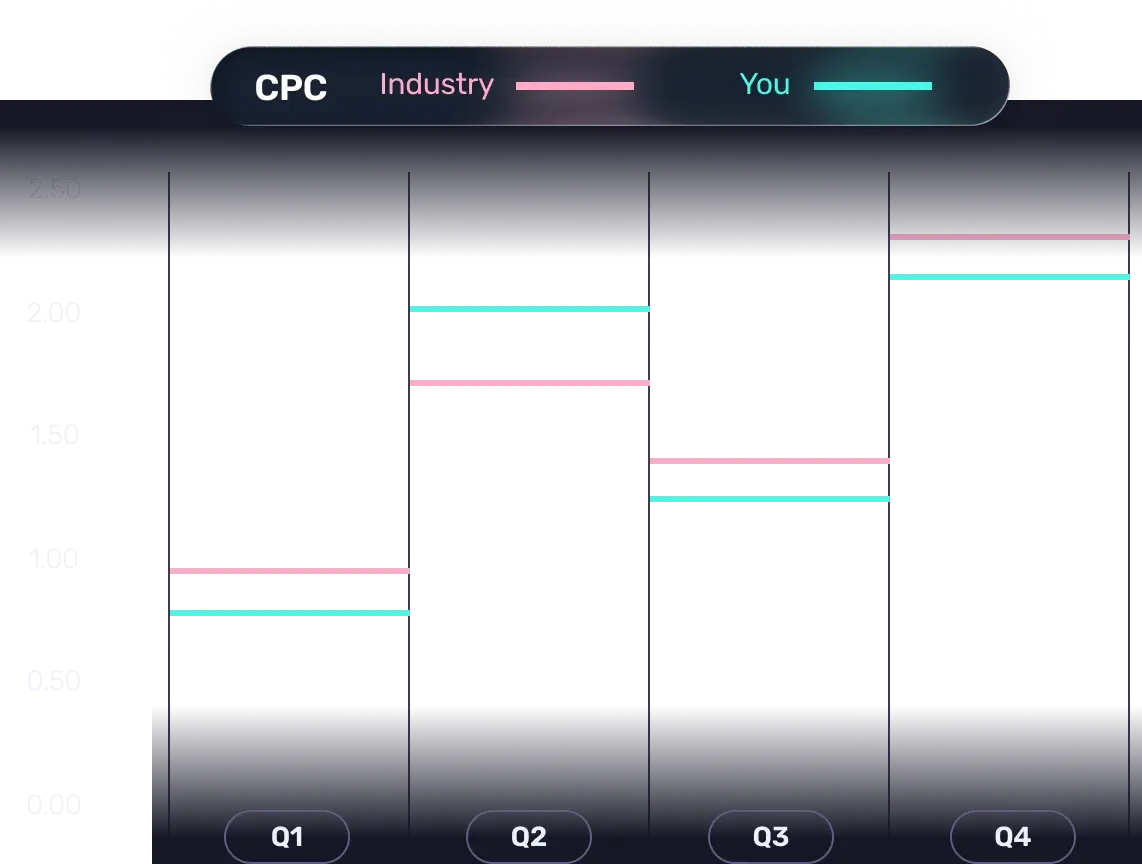
Industry benchmarks give your campaign data the context it needs to actually mean something. Our benchmarks also highlight how key metrics are changing over time, so you are not just comparing static numbers, but how your strategy evolves, compared to your industry.
Spot the gaps and act fast
If your CPC is running significantly above your industry average, your budget is working harder than it should be. Benchmarks make that visible fast, so you can act, not guess.
Set KPIs you can actually defend
Pulling targets out of thin air is a losing game. Benchmark data lets you set realistic, industry-grounded KPIs, the kind your stakeholders can trust and your campaigns can hit.
Understand where to push harder
When you know the average CTR for your campaign type and vertical, you know exactly how much headroom you have. That's where smarter optimisation starts.
When to use them
Benchmarks are not
a one-time check.
The best ecommerce teams return to benchmarks regularly,
especially when something shifts.

When performance suddenly dips
Check whether the shift reflects a broader market trend. If everyone in your industry is seeing lower CTR, it's not your ads, it's the landscape.
When briefing internal stakeholders
Nothing lands quite like industry data. If your CPC is 30% below the category average, that's a number worth sharing in a board update.
When evaluating an agency or partner
Benchmarks give you an independent reference point when an agency presents you with results.
When entering a new market or vertical
Expanding into a new category means competing for clicks you've never paid for before. Get a realistic cost model before committing.
Understanding your cost
What actually moves your CPC?
Cost-per-click isn't a number Google sets in isolation, it's the outcome of an auction shaped by competition and how well your ads are judged to perform. Two forces dominate.
Understanding your engagement
What's driving (or dragging) your CTR?
What's driving (or dragging) your CTR?
CTR tells you whether shoppers are choosing your ads over everyone else's. It's an honest signal. And when it's underperforming, it's usually pointing to one of these two places.